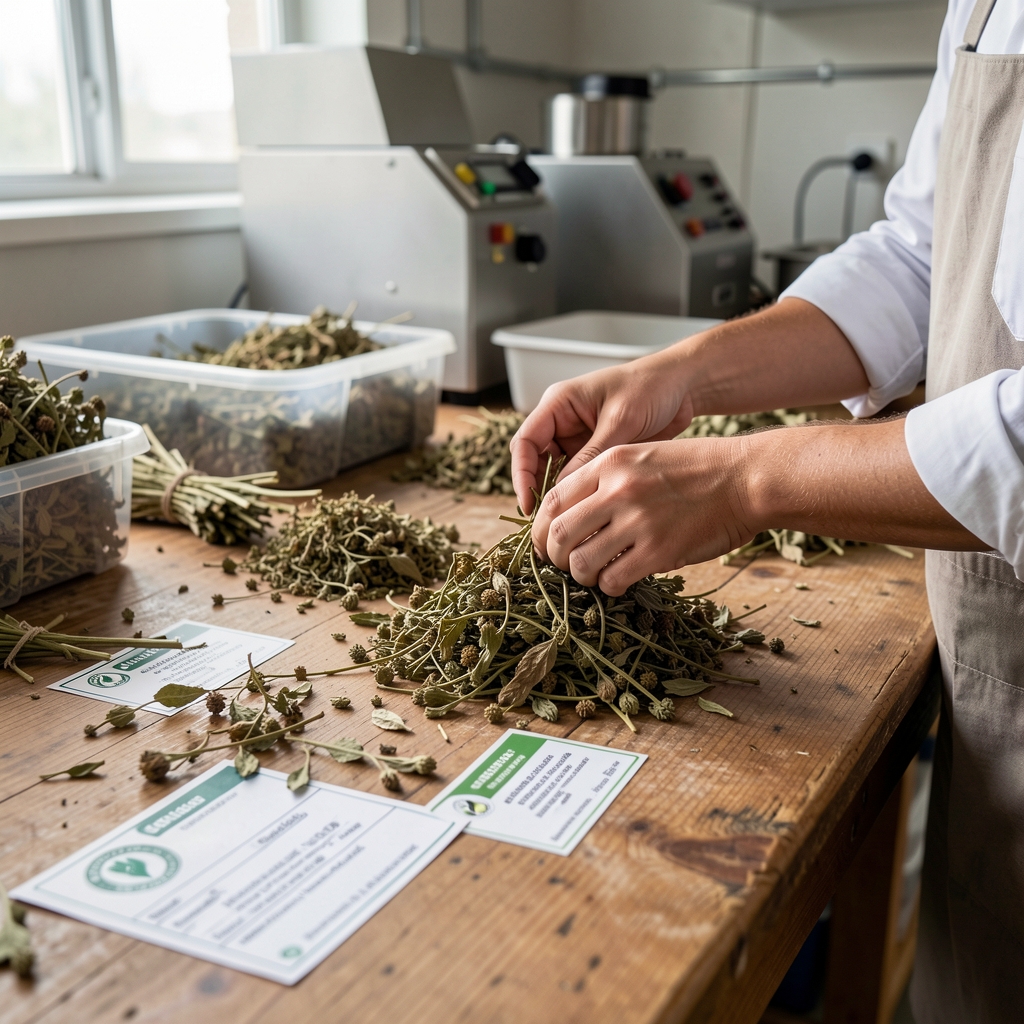
A documented four-stage process applied consistently to every formulation entry in the Drenova catalogue — from initial sourcing review through to published editorial entry.
A supplement guide that relies on the reviewer's subjective assessment is, structurally, a form of advocacy. Drenova operates from a different premise: that the value of a catalogue entry comes from the rigour of the process that produced it, not from the authority of the person writing it.
The four-stage methodology was written before the first entry was added to the catalogue. It defines not what a good supplement is, but what an honest record of a supplement contains. That distinction matters. Drenova does not rank, score, or recommend formulations. It documents them — and the documentation is only as reliable as the process that gathered the information.
The process has not been modified since its first application in 2022. Each quarterly review produces a report documenting which entries passed re-evaluation, which were suspended pending updated documentation, and which were retired from the active catalogue. That report is archived and available on request.
QUARTERLY EDITORIAL REVIEW — ARCHIVE REF. Q1-2026
The sourcing review establishes the ingredient's supply chain from whole-food origin to processed form. The review covers five checkpoints: the raw material's botanical or mineral origin, the geographic location of primary extraction, the processing method applied (cold-press, water extraction, chelation, fermentation), the food-grade standard under which the processing facility operates, and the chain-of-custody documentation that links each batch to its origin.
Where a manufacturer claims whole-food sourcing without supplying chain-of-custody documentation, the formulation does not advance past Stage 1. This is the most common reason for a submission not entering the catalogue. Active ingredients sourced from declared facilities with documented processing standards pass to Stage 2.
Botanical or mineral origin declared
Geographic extraction location verified
Processing method documented
Chain-of-custody document supplied
Every nutrient-role statement in a Drenova catalogue entry is mapped to a published nutritional research basis. The Drenova editorial team uses three reference tiers: EFSA-registered nutrient role statements (the most conservative tier); published peer-reviewed nutritional studies from indexed journals (second tier, used for nutrients with emerging research bases); and documented traditional-use records with at least one corroborating nutritional study (third tier, used for adaptogenic plant materials with established traditional use).
Role statements derived solely from the manufacturer's marketing materials — without citation of a peer-reviewed study or a registered EFSA claim — are not included in the catalogue entry. The entry may still proceed if other aspects of the formulation meet the Stage 1 and Stage 3 criteria, but the unsubstantiated role claim is noted as "undocumented" in the entry.
Authorised EU/UK nutrient role statements. Applied where available. Most conservative reference tier.
Published studies from indexed journals. Used for nutrients with developing research bases not yet covered by registered role statements.
For adaptogenic plant materials. Documented traditional-use record with at least one published nutritional study as corroboration.
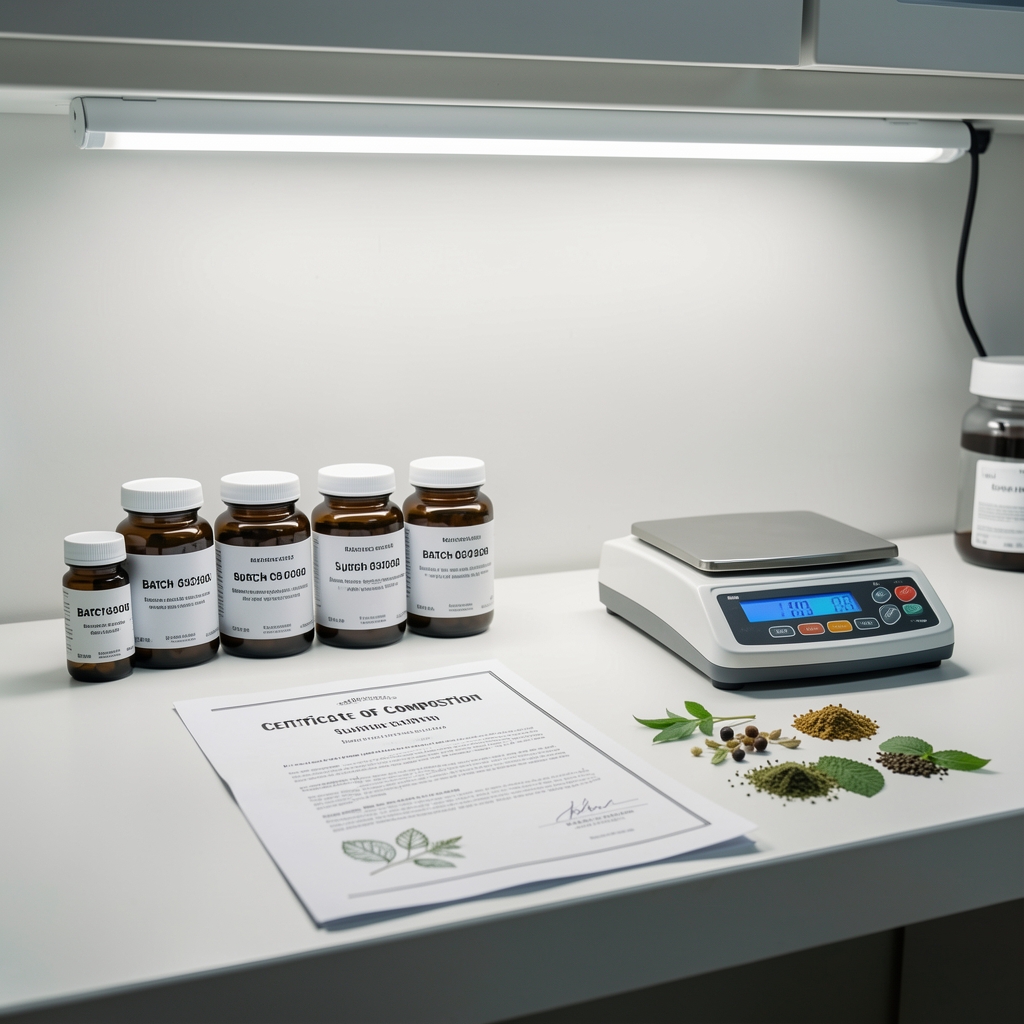
Active ingredients sourced from declared facilities and cross-referenced against the research tier pass to Stage 3 batch verification. This stage requires the manufacturer to supply a certificate of composition from an independent third-party laboratory covering the most recent production batch.
The certificate must confirm: active-ingredient concentration per declared serving, absence of undeclared active compounds, and compliance with the UK Food Standards Agency's upper safe intake levels for all micronutrients in the formulation. Certificates issued by the manufacturer's own in-house laboratory are not accepted at this stage — the independence of the testing laboratory is a formal requirement.
Active ingredients sourced from declared facilities with documented processing standards are entered with the certificate reference number and testing date. Certificates must be renewed annually. Formulations where certificates have lapsed are suspended from the active catalogue pending renewal.
Independent third-party laboratory (not in-house)
Active-ingredient concentration per serving confirmed
No undeclared active compounds present
FSA upper safe intake levels verified for all micronutrients
Certificate renewed annually per production run
Reference number and testing date archived by Drenova
Formulations completing Stages 1, 2, and 3 are written into the catalogue by the editorial team. Each entry follows a fixed structure: ingredient name, serving quantity, source format (whole-food, extract, or isolated compound), origin geography, nutrient-role statement with reference tier noted, batch-certificate reference, and a short editorial note covering any formulation-specific sourcing consideration.
The editorial note is written to the same register across all entries — factual, non-promotional, and free of comparative claims against other formulations. Entries do not rank ingredients against each other. They document each ingredient on its own terms, within its own evidence base.
The entry is reviewed by the nutrition professional on the team before publication. If any nutrient-role statement requires clarification or if the formulation has changed since the Stage 2 review, the entry is returned to the writer for amendment. Only entries that have passed the nutrition professional's sign-off are published in the live catalogue.
The current active catalogue draws from eight documented source regions. Each supplier relationship involves at minimum: a signed declaration of origin, a current food-grade processing certification, and a commitment to supply batch certificates for each production run.
Drenova does not have exclusive supplier relationships. The same supplier may appear across multiple formulation entries. The catalogue records the supplier name as documented on the chain-of-custody form, not as a commercial recommendation. Supplier standing is reviewed annually.
Ashwagandha, bacopa, turmeric. Certified Ayurvedic processing facilities.
Magnesium, pea protein, elderberry. Salt-lake and certified legume farm sources.
Montmorency cherry, sea kelp iodine. UK-certified orchard and coastal harvest.
Lion's mane, reishi, CoQ10. Substrate-verified cultivation and fermentation.
Maca root. Junin plateau certified farms. Annual harvest batch documentation.
Rhodiola rosea. Arctic-origin wild-harvested root. Harvest season documented.
SUPPLIER DOCUMENTATION REVIEW — DRENOVA ARCHIVE 2025
The testing laboratory must operate without commercial relationship to the supplement manufacturer. Drenova accepts certificates from UK-accredited, UKAS-registered analytical laboratories and internationally equivalent accreditation bodies.
Certificates must disclose the analytical method used (e.g., ICP-MS for mineral concentration, HPLC for plant-extract standardisation). Results reported without method citation are handled as unverified.
Each certificate is tied to a specific batch code that corresponds to a production run documented in the supplier's own records. Generic certificates covering a range of batches without individual batch codes are not accepted.
The Drenova catalogue operates on a quarterly review cycle. Each cycle produces three lists: entries confirmed active (documentation current, research basis unchanged), entries suspended (certificates pending renewal or research under review), and entries retired (formulations no longer meeting Stage 1 sourcing criteria, or withdrawn by the manufacturer).
The quarterly review report is a working document — it is not published on the site in its full form, but the active/suspended/retired status of each entry is reflected in the live catalogue. Readers can request a copy of the methodology section from the most recent quarterly report by contacting the editorial team.
Full sourcing documentation renewal cycle
Research reference review, new entry submissions
Batch certificate renewal, mid-year report
Drenova is an independent wellness resource focused on everyday nutrition and active lifestyle practices for men. The content is not affiliated with any governmental or institutional body.
We recommend speaking with a qualified wellness or nutrition professional before introducing any supplement to your daily routine, particularly if you have specific dietary requirements.